What are the Future Homes and Buildings Standards?
In March 2026, the UK Government introduced the Future Homes and Buildings Standards (FHBS), marking a significant shift in how buildings are designed and delivered.
At its core, the update is about reducing carbon emissions and improving energy efficiency. Approved Document L has been reframed to focus on both energy use and greenhouse gas emissions, while Approved Document F continues to address ventilation, with greater emphasis on usability and handover.
Together, these changes aim to ensure that new buildings are fit for a low-carbon future without requiring retrofit later.
When do the changes come into force?
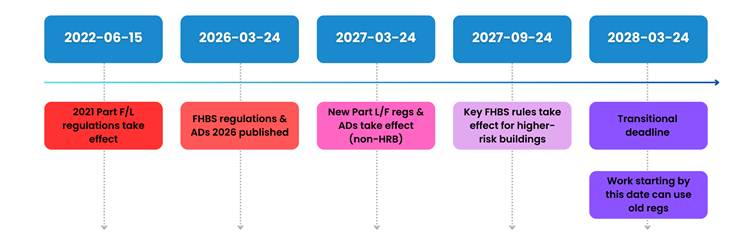
The new regulations come into force on 24 March 2027 for most building work, and 24 September 2027 for higher-risk buildings. Transitional arrangements allow some projects already in progress to follow previous standards, provided they begin before March 2028.
This means that, in reality, most new projects being designed today should already be aligning with the 2026 requirements.
Key Dates for FHBS (England)
What does Approved Document L cover?
Approved Document L sets out how buildings must meet energy efficiency and carbon performance requirements.
For dwellings, this includes meeting defined targets for energy use, emissions and fabric performance. These are calculated through recognised methodologies such as SAP or the Home Energy Model, and compared against target benchmarks to demonstrate compliance.
Alongside these targets, the document sets minimum standards for insulation, airtightness and building services. The intention is to ensure that buildings are not only compliant on paper, but perform efficiently in operation.
What is the new Requirement L3?
One of the most important updates is the introduction of Requirement L3, which mandates on-site renewable electricity generation for new homes.
In practice, this typically means solar PV systems becoming a standard part of residential design. As a result, design teams must now consider roof layouts, orientation and system integration much earlier in the project.
This is a clear move away from offsetting emissions and towards embedding low-carbon energy generation directly into the building itself.
What does Approved Document F cover?
Approved Document F provides guidance on achieving adequate ventilation in buildings, ensuring that indoor air quality is maintained and systems are safe and effective.
The core principles remain consistent with previous editions. It still defines airflow rates, background ventilation requirements and testing standards, alongside expectations for system design and installation.
However, the 2026 update shifts the focus towards how these systems are commissioned, verified and understood by the end user.
What has changed in Approved Document F?
Technically, very little has changed in terms of airflow rates or ventilation strategies. The major shift is in how compliance is demonstrated and communicated.
There is now a stronger emphasis on proper commissioning, accurate testing and the provision of clear, accessible information at handover. This reflects a wider industry recognition that performance gaps often arise not from design, but from poor installation or lack of user understanding.
What is Regulation 40C and why does it matter?
Regulation 40C is one of the most important updates across both Part L and Part F.
It requires that any information provided to building owners must be delivered in an “appropriate format”, meaning it must be accessible, understandable and usable in practice.
This goes beyond basic compliance documentation. It introduces a clear expectation that building users are properly informed about how their systems operate.
The role of the Home User Guide
To support Regulation 40C, the updated guidance introduces a stronger requirement for a Home User Guide.
This guide is expected to explain how key systems—such as ventilation, heating and on-site energy generation—work in everyday terms. It should be provided in both digital and physical formats, ensuring it is readily available to the occupant.
This marks a shift from purely technical handover towards practical usability, helping ensure that buildings perform as intended once occupied.
What do these changes mean in practice?
For developers, contractors and consultants, the implications are clear. Buildings must now be designed with renewable energy in mind from the outset, alongside more efficient fabric and low-carbon heating systems.
At the same time, there is a greater burden of proof. Compliance is no longer just about meeting design targets, but also about demonstrating performance through testing, certification and clear documentation.
Ventilation systems must be properly commissioned and verified, and all systems must be explained in a way that building users can understand and operate effectively.
A shift in approach, not just regulation
The 2026 updates are not simply a tightening of standards. They represent a broader shift in how building performance is approached.
There is now equal emphasis on design, delivery and user understanding. Buildings are expected to generate their own energy, operate efficiently and provide occupants with the knowledge they need to use them correctly.
In short, compliance is no longer just about passing checks, it is about delivering buildings that work in the real world.
Need support navigating the 2026 Building Regulations?
Our fire engineering and compliance experts can help you design with confidence.
Frequently Asked Questions
What is the Future Homes Standard 2026?
The Future Homes Standard is a UK regulation update designed to reduce carbon emissions and improve energy efficiency in new buildings.
What is Requirement L3?
Requirement L3 requires new homes to include on-site renewable electricity generation, typically through solar panels.
What is Approved Document F?
Approved Document F provides guidance on ventilation requirements to ensure adequate indoor air quality in buildings.
When do the 2026 changes come into effect?
The changes come into force on 24 March 2027, with transitional arrangements extending to March 2028.