
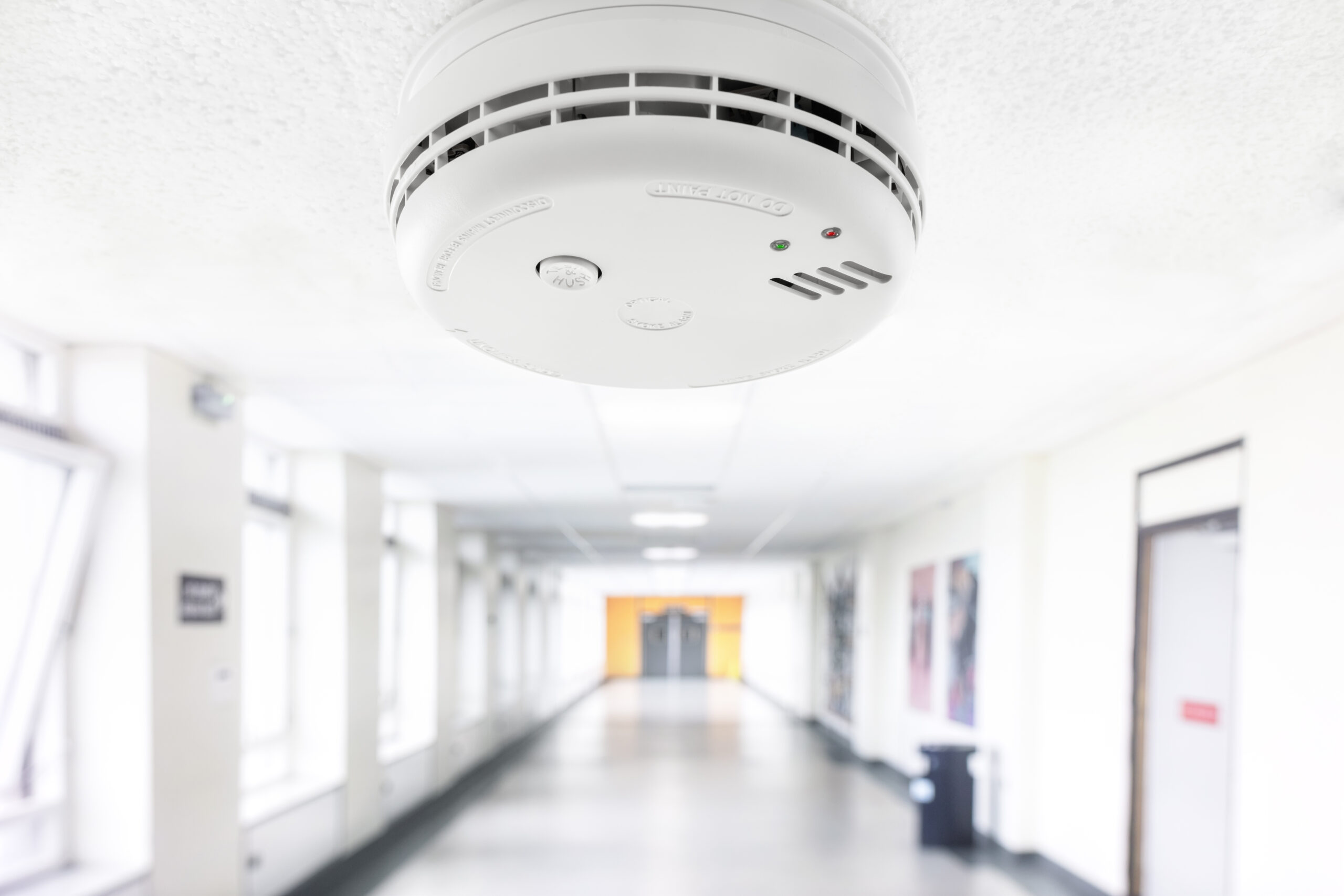
BS 5839-1:2025 came into effect on 30 April 2025, replacing the previous 2017 edition as the British Standard code of practice for fire detection and alarm systems in non-domestic buildings. This comprehensive standard provides updated guidance on designing, installing, commissioning, and maintaining fire alarm systems, reflecting new technology and hard lessons learned from real-world fire incidents.
Developed by a panel of industry experts, the 2025 revision was driven by a strong focus on improving safety after recent tragic fire events. It aligns with current UK building regulations and official fire safety guidance (Approved Document B), underscoring its importance for compliance. For main contractors, developers, and M&E (mechanical & electrical) contractors, it’s critical to understand what’s changed in this new standard and ensure all projects meet these updated requirements. Below, we provide an overview of BS 5839-1:2025, highlight key changes from the 2017 edition, and explain what it means for your responsibilities and projects.
Overview of BS 5839-1:2025 and Its Scope
BS 5839-1:2025 (Fire Detection and Fire Alarm Systems for Buildings – Part 1) is a code of practice focused on fire alarm systems in non-domestic premises (commercial buildings, public buildings, and multi-occupancy residential blocks). It covers all aspects of these systems from initial planning and design to installation, testing, certification, and maintenance. In essence, BS 5839-1 sets the benchmark for how to ensure a fire alarm system is fit for purpose and compliant with UK safety regulations.
In practice, this standard applies to fire alarm systems that include manual call points (break-glass units), automatic fire detectors (smoke and heat sensors), alarm sounders and visual alarm devices, and the fire alarm control panels – including any interfaces that trigger other safety measures (for example, releasing fire doors, shutting down utilities or HVAC, or grounding lifts in an emergency). By following BS 5839-1’s recommendations, building professionals can be confident that their fire detection and alarm systems are reliable and meet regulatory expectations for life safety.
The 2025 edition is a full revision that superseded BS 5839-1:2017 on its publication date. It was developed by BSI’s technical committee FSH/12/1 with a mission to bolster fire safety in the wake of lessons learned from recent fatal fires. The updated standard enhances protection for building occupants by refining where and how detectors should be deployed, clarifying design guidance, and tightening requirements for documentation and maintenance practices. In short, BS 5839-1:2025 aims to reduce fire risks and improve life safety in modern buildings by bringing fire alarm practices up to date with current technology and insights.
Key Changes in BS 5839-1:2025 (Compared to 2017)
BS 5839-1:2025 introduces a range of important updates to design principles, installation rules, system features, and documentation. Here are the major changes from the 2017 edition that stakeholders should be aware of:
- Smoke Detection in Sleeping Areas: To improve early warning for occupants, the new standard prioritizes smoke detectors over heat detectors in bedrooms and other sleeping accommodations. Any area where people sleep (e.g. hotel rooms, care home bedrooms, dormitories) should now be protected by smoke detection for faster response, rather than relying on slower-acting heat detectors.
- Expanded Coverage Requirements (L4 and L2 Systems): Fire alarm system categories have been refined to ensure more comprehensive coverage. For instance, Category L4 (life safety systems covering escape routes) now requires detectors at the top of lift shafts to promptly catch smoke traveling upward. Category L2 (additional detection in defined high-risk areas) has been expanded to explicitly include any rooms where people sleep, not just other high-risk rooms. Even some areas traditionally deemed “low-risk,” such as small lobbies (e.g. toilet lobbies off corridors), now require detectors if they form part of the escape route or the building’s protection strategy under the chosen system category. These changes ensure that fire alarm coverage matches the building’s actual use and risks more closely.
- Manual Call Point Placement: The guidance for manual call points (the “break glass” emergency alarm switches) has been refined. Call points should be strategically placed in areas that are normally occupied, avoiding installation in rarely used or “dead” spaces. The usual rule of locating call points along escape routes and at exits still applies, but the standard emphasises placing them where occupants are most likely to see and use them quickly in an emergency (i.e. places of regular occupancy).
- Integration of Security Lockdown Alarms: Recognising evolving security needs, BS 5839-1:2025 now allows integration of “lockdown” alarm signals (used during security incidents) into fire alarm systems – but only if the lockdown signal is clearly distinguishable from the fire alarm tone. In other words, a fire alarm should not be mistaken for a security alarm and vice versa. This change acknowledges the practice of some buildings using a common system for different emergency alerts, while mandating clear differentiation so that a fire alarm’s life-safety warning is never confused or delayed.
- Detector Positioning & Ceiling Obstructions: There is new, explicit guidance to address potential “shadow spots” that could prevent smoke or heat from reaching a detector. Designers and installers must account for structural elements like deep beams, ductwork, or coffers near the ceiling that could block smoke from a detector’s sensing area. For example, if a ceiling beam is so deep that it might trap smoke on one side, the standard now makes clear that an additional detector should be installed to cover that area. These rules tighten up installation practice to ensure no blind spots in coverage due to the building’s architecture.
- Faster Alarm Monitoring Signals: For fire alarm systems that are remotely monitored (Category L systems connected to an Alarm Receiving Centre), BS 5839-1:2025 sets stricter performance criteria for signal transmission. When an alarm is triggered, the fire alarm control equipment must signal the alarm to the monitoring center within 90 seconds, and any fault in the system must be identified and signaled within 3 minutes. These timing requirements are now clearly defined to ensure a prompt response – both in emergency situations and for alerting maintenance staff to system faults – thereby improving reliability of the monitored alarm service.
- Power Supplies and Battery Backup: The revision clarifies requirements for the alarm system’s power sources. All mains supply cables for fire alarm systems must now be colored red for easy identification. This is to prevent accidental damage or disconnection of fire alarm power feeds among the many cables in a building. Additionally, the standard updates the formula and guidance for calculating the required standby battery capacity for the system’s backup power. Designers and maintenance engineers should re-check battery sizing on existing systems, as the new calculation method may in some cases call for larger capacity batteries to ensure the alarm can operate during a mains outage for the specified duration.
- False Alarm Reduction & Mandatory Features: To combat unwanted false alarms and their consequences, the 2025 standard introduces a couple of important measures. First, fire alarm control panels must now display a “False Alarm Notice” label if the system has an automatic link that calls the Fire & Rescue Service. This prominent notice reminds users and maintenance personnel that any alarm activation will trigger a fire brigade response, reinforcing the need to manage false alarms diligently. Secondly, the standard has tightened what can be treated as a “variation” (deviation) from its recommendations. Certain features are now mandatory and can no longer be omitted by claiming them as optional. For example, providing a zone plan (a layout chart showing fire alarm zones) on site, and having remote alarm monitoring in residential care homes, are now required by default rather than optional extras. These can’t be left out just to save cost or convenience – such omissions would violate the standard. Designers must include these elements, and if for some reason a feature is not provided, it must be justified and recorded as a formal variation in the documentation (with agreement from stakeholders).
- Maintenance and Testing Enhancements: While routine testing and servicing intervals remain fundamentally the same (e.g. weekly alarm tests by the user, six-monthly professional servicing), BS 5839-1:2025 adds flexibility and new expectations for maintenance. Notably, the six-month service interval now has a permitted window of 5 to 7 months and still be considered compliant. This slight flexibility helps with practical scheduling without being judged as a breach, as long as servicing isn’t done sooner than 5 months or later than 7 months from the last check. Each service visit must now include specific tasks: for instance, the engineer must check and correct the control panel’s clock (to ensure event log timestamps are accurate), and it’s recommended to mark the installation date on batteries to track their age for replacement. The servicing technician should also verify that the fire zone chart on site is up-to-date at every visit and update it if needed, remove any detectors or call points that have been decommissioned, and ensure all interfaced fire safety systems (like magnetic door holders or lift returns) are accessible and functioning (no more buried interfaces that can’t be inspected). Furthermore, the standard raises the bar on technician competence by recommending that maintenance personnel engage in Continuing Professional Development (CPD) to stay current with best practices and technological updates. In short, the maintenance process is expected to be thorough and documented, with a greater emphasis on keeping the system info (like time settings, zone plans, device inventory) correct and technicians up-to-date in knowledge.
- Certification and Documentation Updates: All the model certificates and documentation templates have been revised in line with the new standard. Any new fire alarm design, installation, commissioning, or modification should be certified on the updated BS 5839-1:2025 forms (which reflect new clause numbering and terminology). Notably, the standard introduces a new Section 7 dedicated to extensions and modifications of existing alarm systems. Now, if you add to or alter an alarm system in any way – even a minor addition of a few detectors – it should be accompanied by an official Modification Certificate and appropriate records. This ensures traceability of changes and that any expanded system part also meets the 2025 standard. Terminology has been updated for clarity (for example, what used to be called “care homes” are now termed “residential care premises”, and “fire service” is now “fire and rescue service” in all documentation). Crucially, any departures (variations) from the standard’s recommendations must be clearly identified in the design or commissioning documents and recorded in the fire alarm logbook on site. In practice, this means if a designer or installer does something differently (say, doesn’t provide detection in an area that normally would have it, due to a specific risk assessment rationale), that decision must be explicitly noted as a variation, with justification – no more ambiguity in documentation.
- Recognition of Linear Heat Detection: The updated standard formally recognises linear heat detection (LHD) cable systems as an acceptable form of fire detection in scenarios where conventional point detectors aren’t practical. BS 5839-1:2025 now references the relevant component standards BS EN 54-22 (for resettable analogue LHD cables) and BS EN 54-28 (for non-resettable digital LHD cables), integrating these into the fire alarm design toolkit. This means designers can confidently use linear heat detection cables (for example, in environments like cable tunnels, car parks, industrial cable trays or high-ceiling warehouses where LHD is beneficial) and know they are compliant as long as they meet the EN54-22/28 criteria. The inclusion of LHD reflects the advancement in fire detection technology, giving more options to protect challenging environments effectively.
- Inclusivity & Accessibility of Alarms: The revised BS 5839-1 places greater emphasis on ensuring alarms effectively alert all occupants, including those with hearing impairments or other vulnerabilities. There are stronger recommendations to incorporate Visual Alarm Devices (VADs) – such as flashing strobe lights – to supplement audible alarms in areas where deaf or hard-of-hearing persons may be present (for instance, WCs, staff rooms, or areas where ear protection is worn). Additionally, in buildings divided into multiple alarm zones (especially where people sleep, like hotels or large residential buildings), the standard now requires clearly displayed zone plans (fire zone charts) to be installed near the fire alarm panel. This helps both occupants and responding fire-fighters to quickly locate where an alarm has been triggered. Furthermore, for residential care premises (care homes and assisted living facilities), the standard expects that the fire alarm system be linked to an Alarm Receiving Centre or monitoring service so that if an alarm activates, it will automatically notify the fire and rescue service. This ensures a rapid emergency response even if on-site staff are limited, and is now seen as best practice for protecting vulnerable residents. Collectively, these changes aim to make fire alarm systems more effective and inclusive, so that no one is left unaware or unassisted when an alarm goes off.
As we can see, BS 5839-1:2025 is far more than a paperwork update – it brings substantive changes to improve detection speed, reliability, and usability of fire alarm systems. As one industry expert noted, these changes “aim to create faster, more reliable responses to fire, while improving inclusivity and understanding for users of all abilities”. By tightening standards now, the 2025 edition helps future-proof fire alarm systems for modern building risks and diverse occupant needs.
Why Compliance with BS 5839-1:2025 Matters
Compliance with BS 5839-1 isn’t just a box-ticking exercise or bureaucratic burden – it’s fundamentally about protecting lives and meeting legal obligations. This standard plays a critical role in demonstrating that a building’s fire detection and alarm system has been designed and installed responsibly and in line with the law. In fact, BS 5839-1 is directly referenced by UK fire safety legislation and building regulations. For example, Approved Document B (the fire safety guidance that accompanies the Building Regulations) explicitly cites BS 5839-1 as the benchmark for fire alarm systems. This means an alarm system that doesn’t meet BS 5839-1:2025 would likely fail building control approval and could expose the project to enforcement action under the Regulatory Reform (Fire Safety) Order 2005. Non-compliance can lead to serious consequences – project delays, legal penalties, or even prosecution – and insurance companies may refuse coverage or increase premiums if a fire protection system is known to fall short of the accepted standard.
On the flip side, aligning with BS 5839-1:2025 provides positive benefits. First and foremost, it greatly enhances life safety – a compliant fire alarm system offers early warning of fire, supports safe evacuation, and helps contain a fire incident before it grows, all of which directly reduce the risk of injury or death. The updated 2025 standard in particular incorporates real-world lessons (some learned from tragic incidents) to improve system effectiveness when it really counts. Adopting these best practices means your buildings are safer for occupants day-to-day. Additionally, demonstrating compliance shows due diligence and a commitment to quality and safety. For developers and contractors, it reduces liability exposure and future-proofs your projects – you are less likely to face costly retrofits or updates if regulations tighten further, since you’ve already met a high bar. In short, keeping up with BS 5839-1:2025 isn’t just about avoiding trouble; it’s a mark of professionalism and care for the people who will live or work in your buildings.
What BS 5839-1:2025 Means for Main Contractors, Developers & M&E Teams
Implementing the new standard requires action from all parties involved in building projects. Here’s how the 2025 updates affect key stakeholders and what you should be doing to stay compliant:
For Main Contractors & Developers (Design & Planning Phase)
Engage competent fire alarm designers early. The updated standard places greater emphasis on having a qualified person design (or verify) the fire alarm system, and on properly documenting the design decisions. Under BS 5839-1:2025, every fire detection and alarm system design should be overseen by someone with the right expertise, and a formal Design Certificate (per the new model form) must be issued to confirm the system complies with the standard. As a developer or main contractor, you should ensure you appoint a fire alarm specialist (consultant or contractor) who is fully up-to-date with the 2025 standard early in the project, ideally at the planning stage. By involving knowledgeable professionals from the outset, compliance can be “built in” to the design rather than patched on later. Early engagement also allows close coordination between the fire alarm designer, architects, and other building services (mechanical, electrical, etc.), so that things like detector locations and cable routes are planned with the overall construction – avoiding scenarios where detectors end up blocked by ductwork or alarm interface units get hidden behind walls by other trades.
Integrate the fire risk assessment with the design. BS 5839-1:2025 explicitly links the fire alarm design to the building’s Fire Risk Assessment (FRA) – these two should inform each other. In practice, this means the chosen system category (whether it’s a manual M system, life-safety L system, or property-protection P system, and whether L1, L2, etc.) and the placement of detectors must reflect the actual fire risks identified for the building. For example, if the FRA highlights that people will be sleeping on the premises or that certain occupants might not hear an audible alarm, the design must incorporate enhanced protection for those conditions (such as smoke detectors in bedrooms rather than just in corridors, and visual alarm devices for the hearing-impaired). Main contractors and developers should facilitate communication between the fire risk assessor and the fire alarm designer to ensure nothing is missed. It’s also wise to plan for an updated FRA to be completed once the fire alarm installation is finished, reflecting the “as-built” alarm system. In fact, many now treat an updated FRA (showing that the installed alarm meets the assessed needs) as a required handover document – a practice recommended to close the loop between design and final risk assessment.
Double-check the alarm coverage and category requirements. The 2025 standard has introduced stricter criteria for where detection is needed, effectively raising the expected level of protection in some cases. As a project client or main contractor, you should verify early on that the specified fire alarm category is appropriate (or required) for the building’s use under the new rules. The standard now tends to “push” designers toward a higher category if there’s any doubt about risk. For instance, a building that might have been given a Category L3 (escape route coverage) under the old rules could very well need a Category L2 (escape routes plus rooms with high or sleeping risk) under BS 5839-1:2025 if anyone sleeps on site. Developers of care homes or student housing, for example, should plan for a more comprehensive L1 or L2 system – simply meeting the bare minimum from 2017 could now be insufficient. Catching this need in the design phase is crucial; it prevents last-minute changes if a building control officer or fire consultant points out a shortfall later. In summary, ensure the fire alarm specification has been benchmarked against the latest standard’s recommendations for that building type, and don’t hesitate to opt for a higher level of protection if required – it’s easier to do it right from the beginning than to retrofit.
Document any deviations (variations) meticulously. If, due to architectural constraints or a specific fire strategy, the design needs to deviate from a standard recommendation (known as a “variation”), BS 5839-1:2025 requires that this be agreed, justified, and recorded clearly in the design documentation. As a main contractor or client, you should insist on a clear record of any such variations. This not only ensures transparency for approvers (like building control and fire officers) but also protects you by showing that any compromise was made consciously with due consideration and sign-off. All relevant parties (the designer, fire risk assessor, client, etc.) should be in the loop for variations, and the reasoning should be tied back to the fire risk assessment. By enforcing good documentation and sign-off procedures, you’ll prevent ambiguity later if questions arise about why something was done a certain way.
For M&E Contractors (Installation & Commissioning Phase)
Use only competent, certified installers. The updated standard puts a spotlight on the quality and competence of those installing and commissioning fire alarm systems – it’s not enough for a design to be compliant on paper if the installation is poor. All fire alarm work should be carried out by competent persons with appropriate qualifications, and the companies should ideally have third-party certification for fire alarm systems (for example, accreditation under a scheme like BAFE SP203-1 is a strong indicator of competence). As an M&E contractor, ensure your team is properly trained on the new standard’s requirements and consider having your fire division or subcontractor accredited if not already. You’ll also need to produce detailed, traceable documentation for the project – including updated design, installation, and commissioning certificates in the 2025 format – so having a robust internal quality system is key.
Adhere to the new installation guidelines on site. BS 5839-1:2025 introduces several specific installation rules that you must incorporate into your work practices and checklists: – All mains power circuits dedicated to the fire alarm must use red-coloured cables (and ideally be labeled as such). This means procurement needs to source red fire-resistant cable for the mains supply, and your electricians should not substitute other cable colours. It’s a visible change that inspectors will likely look for. – Detector placement must account for ceiling features. Be extra mindful when installing detectors in rooms with beams, soffits, or large ducts near the ceiling.
The new standard spells out when an obstruction is deep enough to necessitate an additional detector on the far side of i. Use the guidance in the standard to decide if you need to install extra detectors to cover any “shadow” areas created by structural elements. It’s good practice to have your site supervisor or commissioning engineer double-check all detector positions before false ceilings are closed up, ensuring no detector is too close to a wall, too low, or blocked by a beam. – Keep interface devices accessible.
If your fire alarm system interfaces with other building systems (such as fire door magnets, smoke control systems, gas shut-off valves, lift returns, etc.), any interface modules or relay units must be installed in locations where they can be accessed for future testing and maintenance. Do not bury these above solid ceilings or in locked risers with no access panel. The 2025 standard explicitly forbids hiding interface equipment in inaccessible spots. Coordinate with the ceiling contractors and others to make sure, for example, a hatch is provided to reach a damper interface box above a corridor ceiling. Failing to do this could mean non-compliance and require re-work later. Follow the design – or formally agree changes.
With the new emphasis on documentation, if you as the installer need to deviate from the original design (perhaps a detector had to move due to a clash with ductwork, or a different sounder type was used), make sure to communicate this to the designer or main contractor and have it documented as an official variation. Don’t unilaterally change things without records. The final documentation handed over must reflect the as-fitted system, and any changes from the plan should be noted and justified.
Thorough commissioning and handover. The commissioning stage now has some extra requirements that you should build into your process: – If the fire alarm is connected to an Alarm Receiving Centre (for automatic fire brigade call-outs), you must affix the new “False Alarm Notice” label on the fire alarm panel during commissioning. Ensure you have these labels available (the text should read to the effect that “This fire alarm has an active connection to the fire and rescue service”). It’s a small but important detail that is now part of compliance. – Test every device and function of the system and document the results.
BS 5839-1 has always required thorough testing, but it now emphasises rotating weekly tests among call points (so over time every call point gets tested). As the commissioning engineer, you should verify each manual call point and automatic detector triggers the system properly and that the signals (sounders, strobes, panel indications, and any remote signalling) all operate as intended.
It’s wise to conduct a soak test – i.e. put the system in service for a week or two prior to handover (with arrangements to monitor any alarms) – to see if any unwanted alarms occur. This can catch issues like detector positioning problems or wiring faults before the building is occupied. – Provide all the updated documentation.
At handover, compile a complete fire alarm manual for the client in line with BS 5839-1:2025’s documentation guidance. This includes the as-fitted drawings (showing the final positions of all devices and cables/routes if required), the design certificate, installation certificate, and commissioning certificate (all in the new 2025 format)[26], a copy of the user guide and logbook, the cause-and-effect matrix (if any cause/effect programming is done), and records of any variations from the standard that were accepted[28]. Make sure to update the zone plan mounted by the panel to reflect any last changes.
The standard also expects that if any part of the system differs from the norm (say, a deliberate disablement of a sounder in an area or an agreed variation), it should be noted in the logbook and explained to the Responsible Person. – Educate the client (Responsible Person). While not a written requirement, it’s good practice under the heightened focus on maintenance that you walk the client or facility manager through the new system. Point out the false alarm notice on the panel and explain their duty to avoid unnecessary alarms (and what to do if one occurs). Ensure they know how to do weekly tests (or that they arrange a maintenance contract for it) and that they have a schedule for the next service (within 6 months). With the push for CPD, consider advising them to use only qualified maintenance providers going forward.
By tightening quality control in installation and commissioning, the new standard ultimately means fewer call-backs and issues for you as the contractor. It’s in everyone’s interest that the system is handed over working flawlessly and with all documentation in order. To that end, you may want to update your internal inspection and sign-off checklists to cover the BS 5839-1:2025 changes. Main contractors and clients are likely to be more vigilant as well – expecting a higher standard of proof that the system meets all requirements. Being proactive in meeting the new standard will demonstrate your professionalism and protect your reputation.
BS 5839-1:2025 is a significant evolution of the fire alarm standard, and it touches every stage of a project from design through installation to maintenance. It clearly delineates duties across the supply chain: designers must be competent and integrate fire risk considerations; contractors must execute installations to a high standard of quality and provide proper certification; building owners and facility managers must keep the systems maintained and documented over the building’s life. The overarching goal of all these changes is to ensure that modern fire detection and alarm systems reliably protect lives and property from day one of occupancy.
For anyone involved in building design or construction, staying compliant with BS 5839-1:2025 is not just about avoiding legal issues – it’s about upholding safety and excellence in your projects. The standard raises the bar, but it also provides a clearer framework that, when followed, will result in better outcomes in fire safety. By embracing these updates and working with experts where needed, you can ensure your developments meet the highest standards of fire protection.
FDS Consult UK is here to help you navigate these changes. As fire engineers, we stay at the forefront of standards like BS 5839-1. Whether you’re a main contractor looking for guidance on compliance, a developer aiming to incorporate the best fire alarm strategy from the start, or an M&E contractor seeking support in system design, our team can provide the expertise you need. Partnering with a knowledgeable fire engineering firm ensures that your fire alarm and life safety systems not only meet the latest standards but are optimised for your building’s specific needs. With the new BS 5839-1:2025 now in force, there’s never been a better time to review your fire safety approach – and we’re ready to assist you in delivering safe, compliant, and successful projects.