
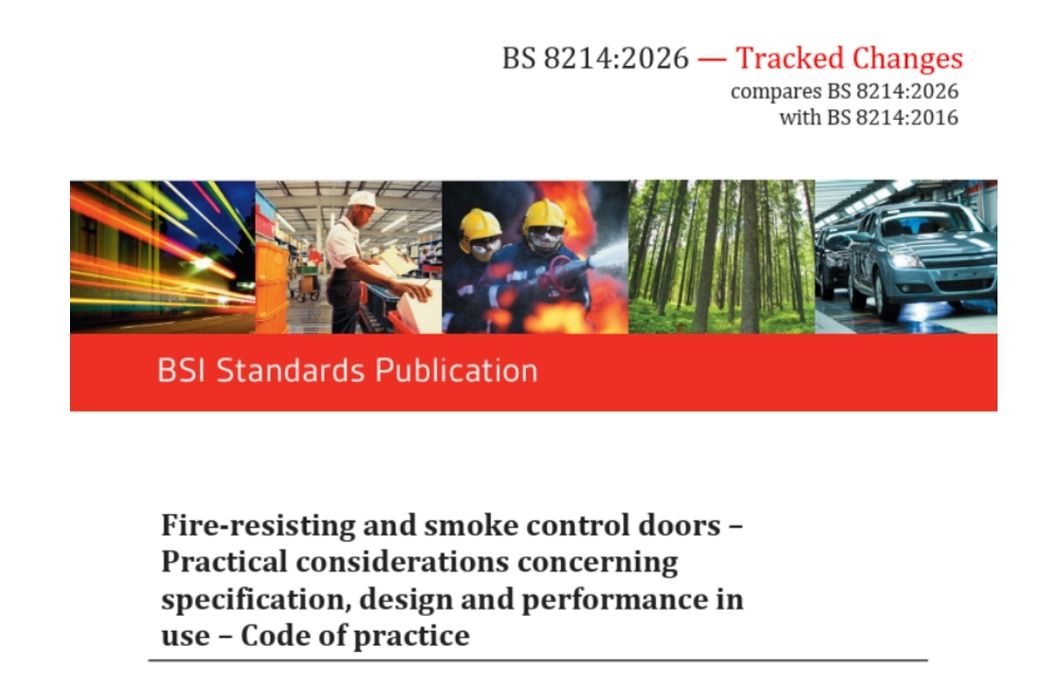
On 20 March 2026, the British Standards Institution published a revised version of BS 8214 – marking one of the most significant updates to fire door guidance in recent years.
And this isn’t just another technical revision.
It’s a fundamental shift in how fire doors are understood, specified and delivered across the built environment.
A Broader, More Realistic Approach to Fire Doors
The previous BS 8214:2016 focused primarily on timber-based fire door assemblies. The 2026 revision changes that completely. For the first time, BS 8214 now applies to fire-resisting doors of all materials, including timber, steel, aluminium and composite systems.
This reflects the reality of modern construction. Fire doors are no longer single products. They’re complex systems, designed, supplied and installed in different ways across projects. The new standard recognises exactly that.
From “Product” to “System”
One of the most important changes is the move away from viewing fire doors as standalone components.
BS 8214:2026 now treats fire doors as a complete, coordinated system, including:
- Door leaf
- Frame
- Hardware and ironmongery
- Seals and glazing
- Installation quality
Because in practice, a fire door only performs as well as its weakest element. Even the highest-spec door will fail if it’s poorly installed or incorrectly specified. The revised standard makes this explicit, closing long-standing gaps between design intent and real-world performance.
Clearer Guidance. Less Risk.
For developers, contractors and duty holders, ambiguity has always been a risk. BS 8214:2026 tackles this head-on with:
- Clearer fire door classifications and supporting evidence requirements
- Improved installation guidance – reducing the likelihood of non-compliance on site
- Updated smoke control recommendations, aligned with BS 9991
- Enhanced guidance on sealing interfaces between frames and surrounding structures
In simple terms: fewer grey areas, more certainty and in today’s regulatory landscape, that matters.
A New Code of Practice for Modern Materials
Another major step forward is the introduction of a formal code of practice for metal and composite fire doors.
Previously, this was a gap in industry guidance. Now, BS 8214 provides a consistent framework across:
- Manufacture
- Installation
- Maintenance
This ensures all fire doors, regardless of material, are held to the same standard of performance and accountability.
Why This Matters Under the Building Safety Regime
The timing of this revision is no coincidence.
With the Building Safety Act, Gateway approvals and increased scrutiny from regulators, evidence-based compliance is no longer optional.
BS 8214:2026 supports this shift by:
- Aligning with modern fire safety legislation
- Reinforcing lifecycle responsibility—from specification through to maintenance
- Providing clearer expectations for duty holders and Responsible Persons
In short, it strengthens the link between design decisions and real-world safety outcomes.
What This Means for Your Project
If you’re involved in design, specification or delivery, the message is clear: Fire door compliance is no longer about ticking boxes. It’s about system performance.
That means:
- Early-stage specification must consider the full door system
- Installation must follow tested and evidenced methods
- Ongoing maintenance must preserve performance over time
Anything less introduces risk, to compliance, approvals and ultimately, life safety.